Đặt lịch khám
Quý khách đã đặt lịch khám thành công
Họ tên :
Số điện thoại :
Ngày hẹn:
VBSP: Burns are common accidents in daily life. Burns in children account for a relatively high rate, local first aid and transfer to reliable medical facilities for proper treatment play an important role in successful treatment, while reducing costs. poorly, reducing burn sequelae, shortening treatment time.
On April 26, 2016, the National Burn Institute treated a patient with an alcohol fire burn of 10% of his body area (of which 8% were deep burns) on his right leg. Lien Bao's hometown, Vinh Yen city, Vinh Phuc, case number 3545.
Through medical history, it is known that on April 11, 2016, the patient was playing with alcohol, causing burns. After that, the patient was given first aid and treated at a private medical facility in Vinh Yen. Due to the inability to distinguish between superficial and deep burns, the patient was still kept for treatment at this facility. The patient's bandages were changed once every 4 days, the wound exuded a lot of fluid and the smell was very bad. On April 26, 2016 (after being burned for 15 days), the patient's family resolutely transferred to the National Institute of Burns (Not an active treatment facility).
Patient's condition when transferred to Burn Institute: At the site of injury 10% of the body area, of which 8% of the burns are deep, necrotic wounds have shed moderate purulent secretions, granulomatous tissue edema, many pseudomembranous membranes, foul-smelling exudate , the risk of causing knee deformity, affecting movement due to the patient's anti-pain posture.
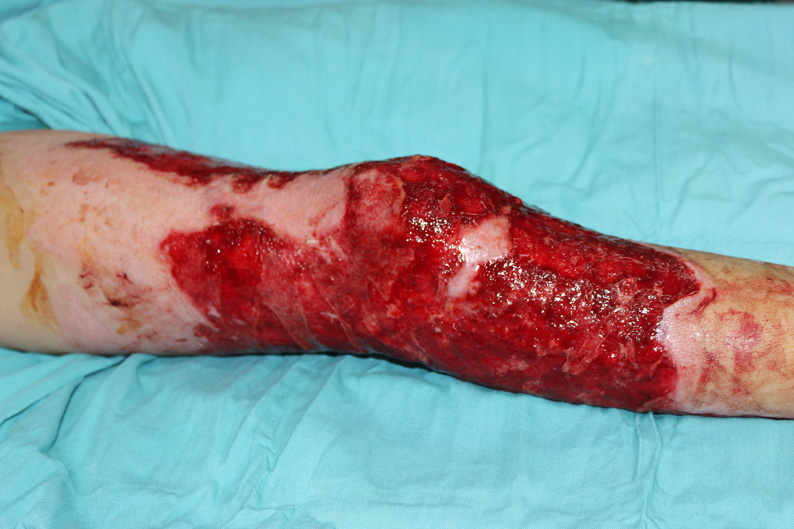
Image of the wound before surgery
After admission, the patient was actively treated: surgical resection of bad granulation tissue under the tourniquet, skin grafting. The skin graft results were good, the patient recovered after 14 days of treatment (April 26 - May 10, 2016).
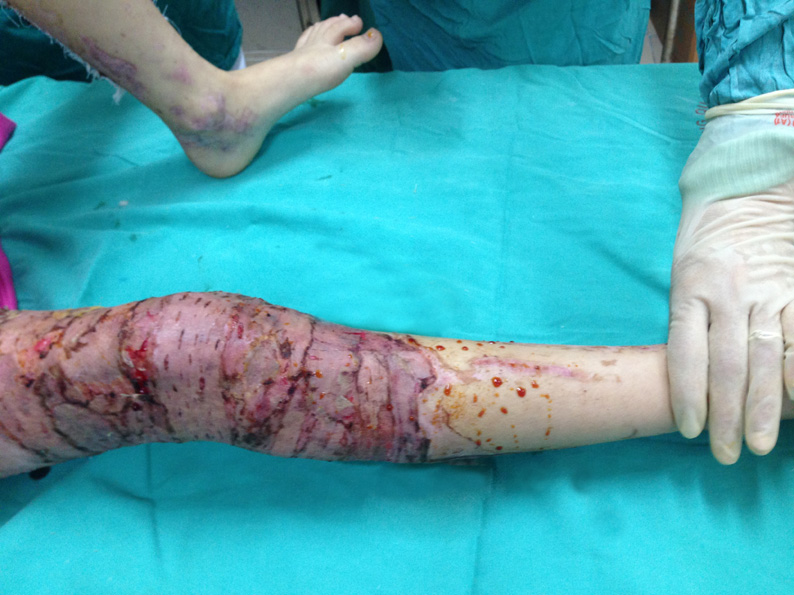
Wound image after 14 days of treatment
In fact, on this patient, we draw the following observations:
- First of all, it must be confirmed that this patient cannot be cured by medical treatment. Patients necessarily need surgery to remove necrotic tissue, skin grafts when conditions permit. This is the most common mistake with patients self-treating at private medical facilities without specialized knowledge of Burns.
All cases of deep burns need to be treated in specialized facilities:
- Burns with area and depth in this patient have other risks such as burn shock, dehydration, electrolyte loss, risk of infection, decreased resistance...all can lead to life-threatening complications.
- Burns to the extremities, joints, with the risk of severely affecting function if not treated properly. Patients may leave scars deforming these positions, pulling and affecting movement.
So how should this case be handled:
- In situ: Soak the burn, conduct area and depth diagnosis. Change the first treatment tape as prescribed.
- Other measures such as warming, oral rehydration, electrolytes, nutrition...
- It is necessary to quickly transfer the patient to a medical facility with enough emergency resuscitation equipment to combat shock, prevent infection, etc., bring the patient through the critical stage, then quickly transfer the patient to the central level for further treatment. Other intensive interventions
Through the above case, we give some warnings as follows:
- All people who are burned need to properly perform first aid measures on the spot and transfer to trusted medical facilities for proper treatment, do not self-treat or treat at medical facilities. unauthorized
- When there are serious signs that cannot be treated, medical facilities need to quickly transfer to a higher level.
Nguyen Bang Tam - National Institute of Burns
Tin mới nhất